

Every time it rains, a large puddle forms in your garden. Your shoes get muddy. Plants you just transplanted are mysteriously rotting from the roots up. Many homeowners struggle with this exact problem: a waterlogged garden that just won’t drain properly.
The typical fix is to buy a bag of sand or gravel and spread it on the surface. In most cases, however, the puddle comes back within a few months to a few years. Why?
The answer is simple. A drainage problem isn’t a surface problem — it’s a problem deep inside the soil. No matter what you spread on top, water will keep collecting as long as the airflow and water pathways underground are blocked.
In this article, we’ll combine insights from thousand-year-old traditional Japanese architecture with modern regenerative landscaping to show you 4 DIY steps anyone can use at home to fix a waterlogged garden. Unlike just adding gravel, this approach builds a garden whose drainage improves over time — from the principles, through specific steps, all the way to common mistakes to avoid.
日本語版: 庭の水はけを根本から改善する|水たまりを消す土の呼吸を取り戻す手順
Why Your Garden Stays Waterlogged — It’s a Soil Problem, Not a Surface Problem
Puddles are the symptom, not the cause. The real reason your garden stays waterlogged is almost always that the airflow and water pathways inside the soil have become blocked.
Three Signs Your Garden Has Poor Soil Drainage
Before doing anything else, check whether your garden shows these three signs:
- Sign 1: Puddles remain hours after the rain stops — and reappear in the same spot every time
- Sign 2: Green slime, moss, or algae spreads on the surface (a sign water is stagnant underground)
- Sign 3: Plants die for unclear reasons, and their roots appear blackened or rotten when dug up
If two or more of these apply, there’s a high chance the soil’s natural airflow and water movement are no longer functioning.
Why Sand and Gravel Recurrences Happen
Spreading sand, gravel, or compost on the surface often produces visible improvement for the first few months. But within 1–3 years, the puddles tend to return in the exact same locations.
Why? Because if there’s no underground pathway for water and air to actually move, adding absorbent material on the surface only stalls the water at a slightly different layer. Imagine a cup with no hole in the bottom — no matter how much water you pour, it has nowhere to go.
To make matters worse, the non-woven filter fabric (often sold combined with weed barrier) commonly used in drainage projects becomes clogged with roots and mycelium within a few years, ending up as something close to a concrete slab. Surface-only fixes often make things worse over time, not better.
The Three-Element Wisdom of Ancient Architecture: Water, Air, and Mycelium
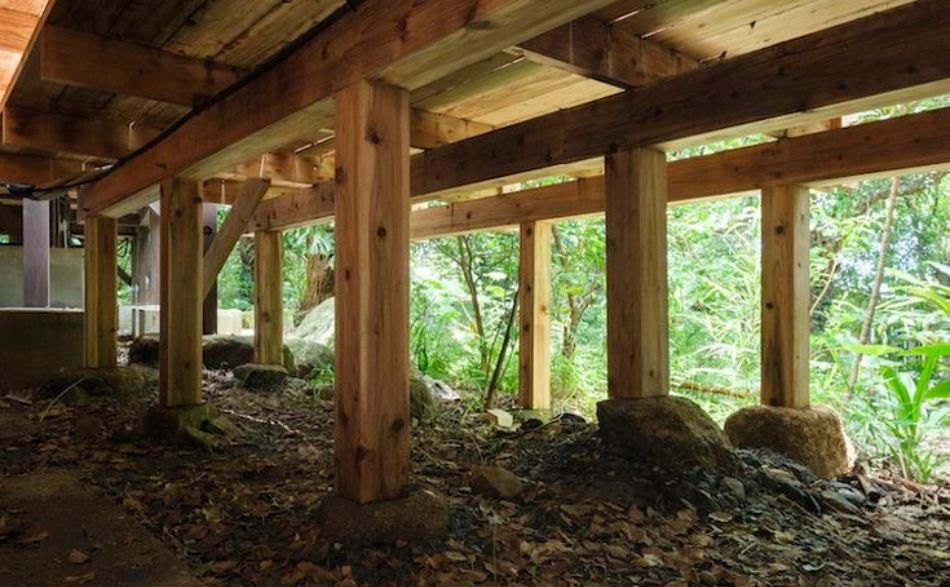
So what’s the actual solution? When you look at structures that have stood for over a thousand years — like the embankments of Kamakura-era castle ruins or the foundations of Horyuji Temple — a common design principle emerges. Those structures preserve a soil structure where three elements coexist continuously: water, air, and mycelium.
- Water: Rainwater and groundwater move and percolate gently without stagnating
- Air: Air flows in and out of the soil through pore spaces — not only at the surface but deep underground
- Mycelium: Fungal networks bind soil particles, purify water, and unify the soil’s structure
When these three elements are present, the soil’s drainage capacity doesn’t degrade over time — it actually improves. This has been observed across many regenerative landscaping sites. Even at the scale of a home garden, the same principle works.
4 DIY Steps to Fix a Waterlogged Garden
Here are 4 practical steps that translate professional regenerative landscaping techniques into something a homeowner can do over a few weekends. You don’t have to do everything at once — progress in small batches is perfectly fine.
Step 1: Map Where the Puddles Form After Rain
Before digging anything, start with observation. The morning after a rain, walk your garden and note every spot where water is pooling. Take photos with your phone, or sketch a quick plan to create a “puddle map”.
Three things to check:
- The exact location and size of each puddle (20 cm wide? 1 meter?)
- Whether puddles cluster in low spots, or also appear in seemingly flat areas
- How long each puddle takes to disappear (an hour? a full day? still there the next day?)
If the same locations puddle after 3 to 5 separate rains, those are your top priority sites. Don’t decide based on a single rain — observe at least twice before moving to the next step.
Step 2: Dig ‘Tenana’ (Point Holes) to Open Vertical Air-and-Water Pathways
“Tenana” (点穴 — literally “point holes”) are vertical channels that open up underground airflow and water percolation. For home use:
- Position: Center of the puddle, or the lowest point
- Size: 20–30 cm wide; 50–80 cm deep (reach through the clay layer if possible)
- Digging: A simple shovel or spade is enough. Keep the excavated soil to one side — you’ll need it
- Fill order, from the bottom: Coarse crushed stone (about 5–10 cm pieces) filling half the depth → a 10–20 cm layer of fallen leaves, dead grass, and small branches → finer gravel → a small amount of charcoal (regular barbecue charcoal works) at the top → cover the upper half with the original soil you set aside
What’s crucial here is the mindset: this isn’t just a drainage hole — it’s also an air hole. Letting air down into the soil activates fungal microbes, and over time the soil structure becomes increasingly granular (particles separated by air spaces).
For a typical home garden, aim for at least 2–3 tenana. For larger gardens, 5–10 will produce more noticeable change.
Step 3: Connect Tenana with ‘Mizumichi’ (Water Channels)
Tenana alone work, but connecting several with shallow water channels (mizumichi) produces a more area-wide improvement.
- How: Between two tenana, dig a narrow trench about 30 cm deep and 20 cm wide
- Fill: Small stones at the bottom, branches and leaves on top, then cover with soil
- Layout tip: Avoid straight lines. Make the channels curve gently (meander). Cutting them diagonally across any slope adds further effect
The reason for curves: a straight channel either drains too quickly (eroding soil) or stops moving water altogether. Natural rivers and streams always meander, and the same gentle curvature creates the right balance between water flow and soil retention.
Step 4: Use Planting to Grow a ‘Root Network’
After the tenana and mizumichi, the final step is planting. Plant roots are what keep the structures you built alive and functioning long-term.
The ideal plants are native species that grew on the land originally. Use plants you see in your local hills or wild areas, or seek out the “native plant” section at a quality nursery. Mix layers of tall trees, medium shrubs, small shrubs, and ground cover so the root network grows in three dimensions.
A useful planting tip: place each plant 30–50 cm away from the edge of a tenana, not directly above it. Roots grow better at a small distance and naturally extend toward the structure underground.
What Changes to Expect — Drainage That Improves Over Time
“Will this actually work?” is a fair question. In regenerative landscaping projects, the changes after construction are documented in numbers. At the home garden scale, the changes are smaller in size — but the same in nature.
One Week After Construction
About a week after you build a tenana, you’ll see a thin white layer of fungal mycelium begin to spread across the leaves and branches inside the hole. This is the sign that underground airflow has been restored and soil microbes are active. If you touch it, you’ll feel a soft, web-like fungal mat.
Two Weeks After Construction
The bad odor often found around stagnant puddles disappears around this time. The chain of decay driven by anaerobic (oxygen-hating) microbes stops, and aerobic microbes take over. The soil shifts from “swamp smell” to that familiar healthy-soil aroma.
One Year After Construction
In professional regenerative landscaping, there’s recorded data of how long a 20 cm puddle takes to fully soak in after installation on clay-heavy land:
- Immediately after construction: about 3 hours to fully drain
- One year later: tens of seconds to a few minutes (rapid absorption)
In other words, regenerative-style installations don’t decay over time — their function grows. This is something concrete drains and chemical treatments simply cannot replicate. It’s the unique property of living soil.
Why a Staggered (Zigzag) Layout Matters
One more thing to know: how to arrange multiple tenana matters. If you line them up perfectly straight, the soil between them turns into a shortcut channel, with water rushing through one line while the rest of the garden remains dry.
To prevent this, place tenana in a staggered (zigzag) pattern. This same principle was used in ancient civil engineering for stepped earthworks, ensuring that water and air spread evenly across an area rather than collapsing into a single track.
Common Mistakes to Avoid
Here are the most common pitfalls in DIY garden drainage projects, and how to avoid them.
Mistake 1: Digging a Hole and Backfilling It Empty
Some homeowners assume that simply digging a hole and putting the dirt back in will fix the problem. Within weeks, the hole collapses on itself and any benefit disappears. You must layer in stones, leaves, branches, and charcoal to maintain a structure with airspaces between materials.
Mistake 2: Walling Off Puddles with Concrete or Blocks
If you build a concrete or mortar wall around a puddle to “dam it off,” you completely block water and air pathways. The puddle disappears from view for a while, but underground, water and air stagnate. Within 10–15 years, the wall itself can collapse.
Mistake 3: Installing Non-Woven Filter Fabric
Filter fabrics sold as drainage media get clogged with roots and mycelium within a few years. They cut off the continuity of living soil, which is why regenerative-style projects almost never use them.
Mistake 4: Paving Over Everything with Concrete or Lawn
Paving the whole yard to “reduce maintenance” eliminates all rainwater absorption pathways, sending puddles to your property boundary. Always preserve some unpaved planting area so rainwater has somewhere to breathe.
Site-Specific and Seasonal Decisions
Drainage improvement isn’t “one-size-fits-all” across all gardens and seasons. Here’s how to adapt the basic approach.
Best Seasons: Spring and Fall
The ideal time for installation is spring (March–May), just before the rainy season, or fall (September–November), during the long autumn rains. Plant roots are most active in these periods. Avoid the peak of summer and the dead of winter, when soil microbe activity slows down.
If You Have Clay Soil
On heavy clay soil — for example, Kanto loam or red clay — dig your tenana deeper, around 80 cm to 1 meter. The goal is to break through the clay layer down to the permeable soil below. If deep digging isn’t possible, increase the number of tenana to compensate by area.
If You Have a Small or Courtyard Garden
Even in gardens of 30 m² or less, mini-tenana (15 cm wide, 40 cm deep) at 2–3 spots can be effective. Combining them with potted plants placed around the tenana — instead of in-ground planting — is another good option.
For Renters
If you’re renting, large-scale digging usually isn’t allowed. Even so, mulching with branches and leaves on the surface, or making simple mini-tenana covered with terracotta pots or burlap, are relatively easy to remove when you move out. Design with restoration in mind.
Summary: 5 Key Points for Fixing a Waterlogged Garden
- Garden puddles are a soil problem, not a surface problem — spreading gravel alone tends to fail within a few years
- The fundamental fix is recreating the “water, air, and mycelium” trinity that ancient long-lasting structures preserve
- The 4-step DIY approach: ① Map puddles after rain ② Build tenana (vertical airflow/drainage holes) ③ Connect them with mizumichi (curved water channels) ④ Plant a native, multi-layer root network
- The function grows over time — mycelium appears in a week, bad smell disappears in two weeks, and drainage speed improves dramatically within a year
- Mistakes to avoid: backfilling empty holes, walling off with concrete, using non-woven filter fabric, and paving over everything
Frequently Asked Questions
Q1. Do I need special tools to dig a tenana?
For a home garden, a regular shovel, spade, and sieve (to separate stones from soil) are enough. Only if your clay layer is unusually deep would you want to rent a small auger. Materials like crushed stone, leaves, and charcoal can usually be sourced from hardware stores combined with foraging — typically a few hundred yen per tenana.
Q2. How long until I see results?
You’ll notice puddles draining faster within days. The deeper transformation — where soil becomes granular and drainage accelerates dramatically — takes about 3 months to a year. Mycelium networks need time to mature. Even if surface changes seem slow, underground change is happening steadily.
Q3. Can I apply this to a balcony or rooftop garden?
You can’t dig tenana into a balcony surface. However, the same principle works in large planters: layer crushed stone, charcoal, and leaves at the bottom of the pot. This drastically reduces root rot and tends to extend plant lifespan.
Q4. What if I want immediate visual results?
This method is built around function that grows over time, so dramatic visual change isn’t immediate. If you need a polished look right away, install tenana and mizumichi, then top with decorative gravel or thin moss mats. After a year, the soil beneath quietly regains its function while the surface stays beautiful.
Q5. What does it cost to hire a professional?
Costs vary widely depending on garden size, current conditions, and the number of tenana needed. For a typical residential garden of around 70–100 m², expect roughly USD 1,500–6,000. While more expensive than DIY, professionals offer the advantage of holistic soil assessment, tenana layout design, planting plans, and seasonal timing.
Q6. Where can I learn this more systematically?
For a deeper, structured learning path, see EKAM’s online course. It covers everything from soil reading and seasonal decision-making to long-term maintenance, with video lessons and personalized support. Suitable for both professionals and committed DIYers.