

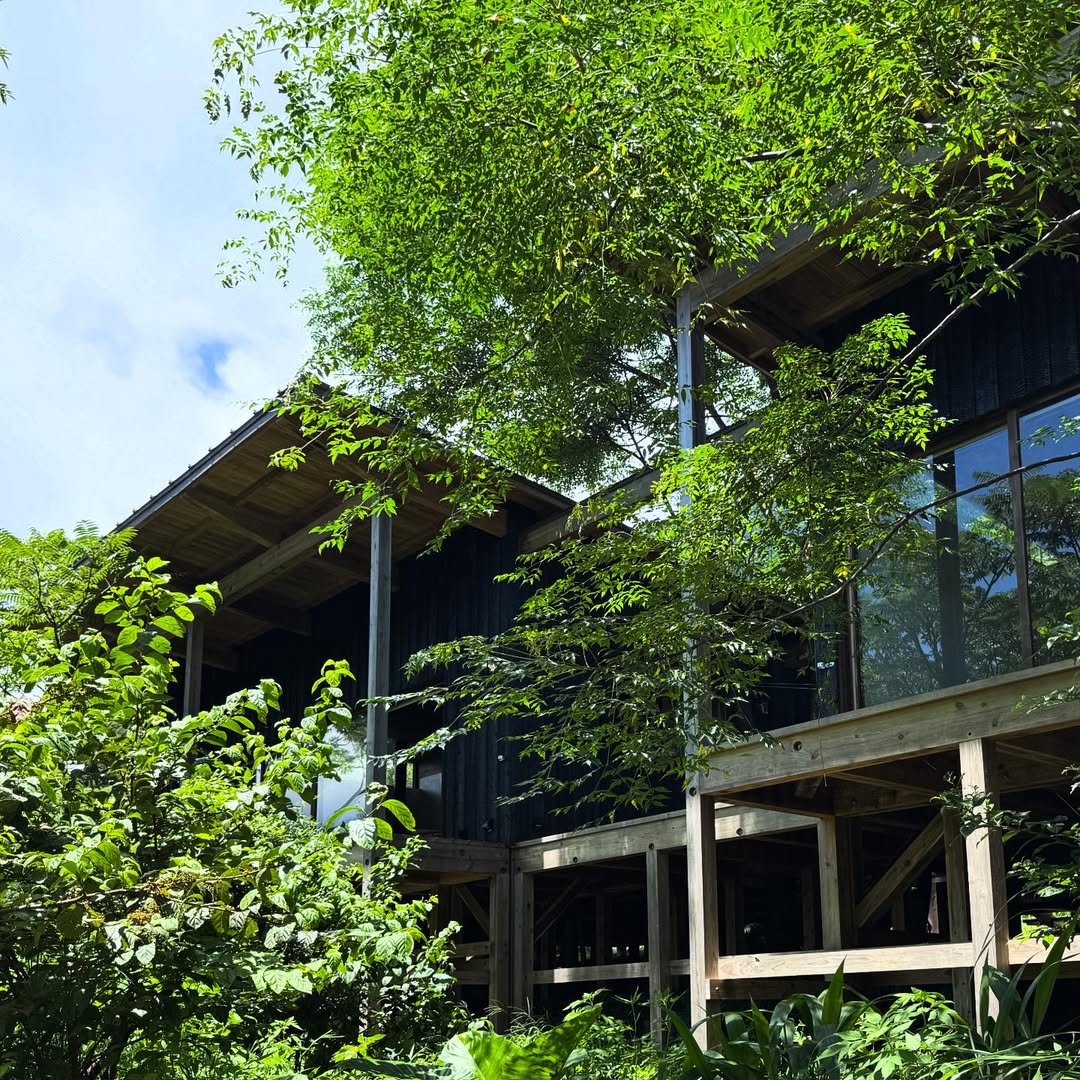
“Architecture that makes the land richer the more we build.” The number of designers who resonate with this idea has grown sharply in recent years. In the global architecture community, the value shift from “sustainable” to “regenerative” is now mainstream — and at international awards such as IADA, IDA, and Asia Design Prize, projects that restore the earth and its ecosystems are taking the top tiers.
At the same time, when designers actually try to start a regenerative architecture project at their own studio, many tell us they struggle with where to begin and which part of the standard design flow to rewrite.
This article shares 7 design perspectives we believe are essential when designing regenerative architecture, written from our position as practitioners who have worked on regenerative civil engineering, landscape, and ishibadate (Japanese traditional stone-base construction) projects in Yakushima, Bali, and sacred forests around shrines and temples in Japan.
What Is Regenerative Architecture — from “Sustainable” to “Regenerative”
The Difference Between Sustainable and Regenerative
“Sustainable architecture” is built on the idea of not making things worse. Improving energy performance, reducing CO₂ emissions, lowering material impact — all important, but the vector points toward “bringing the negative closer to zero.”
“Regenerative architecture,” in contrast, takes the position that the very act of building and living should actively restore land, water, air, and ecosystems. Architecture that creates a plus, not just minimizes a minus. This is one of the most closely watched value axes in global architectural awards today.
Designing the Land, Not Just the Building
The starting point of this shift is to stop treating “the building” as the sole object of design. Rather than focusing on the building’s performance alone, the prerequisite becomes designing the entire site as a single ecosystem — topography, water flow, soil, vegetation, microbial life, and relationships with neighboring lands.
On the regenerative residential projects we work on, the building drawings and the landscape drawings are not separate documents. The image is closer to this: a drawing of topography and water flow is laid down first, and the outline of the building is gently placed on top of it.
Rewriting the Starting Point — Reading the Site’s Ground, Water, and Ecosystem
The first step to rewrite in regenerative architecture design is not the drawing — it is the site survey. If you don’t increase the resolution here, the land won’t respond to whatever beautiful design you place on top of it later.
Measure Topography and Underground Water Flow
A standard site survey focuses on bearing capacity and boring data. The flow of water and air through the ground is rarely described. In regenerative architecture, however, the movement of air and water through the soil is the single largest variable that determines both the building’s lifespan and the land’s long-term health.
Map out the contour lines, existing trees, springs, wetlands, traces of old streams, and surrounding valley lines. Then redraw the entire site from the perspective of “how do water and air actually flow through it?” Whether or not you spend even a single full day on this step will completely change everything that follows in the design process.
Understand Soil Physical Properties (Drainage, Aeration, Water Retention)
Beyond bearing capacity, always assess soil drainage, aeration, and water retention — what we call soil physical properties. If you cap a clay-heavy site with a concrete slab foundation, the surrounding soil will lose its function within just a few years, and trees nearest the root zone are the first to decline.
To build while keeping the soil alive, you must first diagnose whether the existing ground is “breathing.” Test pits and infiltration tests, done in partnership with a landscape or civil engineering team, take only a few hours and offer extremely high cost-performance as material for early design decisions.
Decide Building Placement Assuming Existing Vegetation and Microbial Life Remain
Existing trees are not “landscape elements” — they are hosts for soil microbial communities. The root zone of a single mature tree houses hundreds of species of microbes, fungi, and small animals. Whether to remove or preserve them directly determines the ecological continuity of the site.
The iron rule of regenerative design is to draw the building footprint first along the line that preserves the maximum amount of existing trees and soil ecosystems. The order of “place the building first, then patch things up with landscaping” will never unlock the site’s full potential.
Rewriting the Foundation — Ishibadate as a Thousand-Year-Proven Option
The element that designers struggle with the most in regenerative architecture is the foundation. A concrete slab feels safe, but in the sense of completely sealing the ground, it is the opposite of regenerative thinking.
A Structure Where Columns Simply Rest on Foundation Stones
As an alternative to sealing the ground with concrete, Japan has a thousand-year-proven traditional construction method called “ishibadate” (stone-base construction). It places wooden columns directly on natural foundation stones, with no rigid connection — “simply resting” on the stone. Many of the surviving thousand-year-old wooden buildings in Japan, including Horyuji Temple, are built this way.
People often feel uneasy at the idea of “a house that isn’t held down by concrete,” but the truth is the opposite: the column’s ability to shift slightly on top of the stone gives the structure a seismic isolation effect, allowing it to release earthquake energy rather than resist it head-on. Receiving force flexibly rather than rigidly is the common philosophy across traditional Japanese construction.
An Open Underfloor That Preserves the Ecosystem
The defining feature of ishibadate is that the point-based placement of stones and the raised floor allow soil, water, air, and small animals to pass freely beneath the building. Even with a building standing on top, rainwater still infiltrates the ground, soil microbial communities stay connected, and plants can continue to grow — it is a rare structural method anywhere in the world that lets you place a building on a site without severing its ecosystem.
Beneath the foundation stones, compacted crushed stone and gravel form a base that secures both drainage and aeration. The open underfloor space also allows wood to dry naturally, while the humidity- and temperature-regulating function of the stone, soil, and wood gives residents cool summers and gentle winters.
A Material Composition That Returns to the Earth at the End of Life
Stone, wood, earth, grass, bamboo, charcoal — the materials used in ishibadate return directly to the soil when the building is dismantled. This represents a fundamentally different end-of-life design compared to the industrial waste generated by demolishing concrete-and-rebar buildings.
In an era where buildings are evaluated by their full lifecycle environmental impact, end-of-life dismantlability is a requirement that must be embedded in the initial design. The Yakushima ishibadate residence “Regenerative Vegan House,” constructed by EKAM, was recognized for embodying this full-circle architectural philosophy, earning multiple international awards including Asia Design Prize 2026 Gold Winner, IADA 2026 Platinum Winner, and Global Architecture Awards 2025 Gold.
Designing Across the Full Lifecycle
In regenerative architecture, the evaluation criteria for design extend well beyond “in-use energy performance.” You need to design with a view that spans from before construction to after demolition as a single design subject.
Environmental Load from Construction to Demolition
The full evaluation of regenerative architecture sums up five stages: ① embodied carbon in material production, ② construction-phase energy, ③ in-use operational energy, ④ maintenance load, and ⑤ end-of-life waste. Keeping this in mind at the initial design stage will dramatically change the priority order of your foundation, structure, insulation, and finish material choices.
Structures That Allow Partial Repair and Replacement
Once a concrete frame is built, it cannot be replaced even when it deteriorates. Traditional construction methods, on the other hand, are built on the premise of partial repair — replacing columns, beams, floors, and earth walls one element or one surface at a time. Designing on the assumption of 100-year use, anticipating which parts will deteriorate first and how they can be replaced, is one of the areas where architects can contribute the most. This design philosophy is exactly why shrine and temple buildings have lasted for a thousand years.
Local Materials and the Continuation of Craft
Long-distance transport of building materials trades CO₂ for the weakening of local economies. Designs that draw on stone, wood, soil, and craftsmanship from within a few dozen kilometers of the site lower the building’s environmental load while keeping technique alive in the region. “Did this project regenerate local technique and economy?” is part of the evaluation axis for regenerative architecture.
Don’t Separate the Building from the Landscape
In regenerative architecture, building drawings and landscape drawings move in parallel from day one. In fact, it is fair to say “landscape first, building second.”
Cycle Rainwater Within the Site
Don’t make a rainwater plan that routes runoff off the site. Instead, plan from the start to infiltrate rainwater into the ground within the site. Returning rainwater to the underground water network preserves the soil’s aeration and infiltration. Rather than flushing it away through surface drains, options like infiltration shafts (vertical holes filled with charcoal and bamboo) and water-flow grooves become drainage designs in which the soil keeps breathing.
Traditional construction sites do not use non-woven fabric filters. The reason: such fabric clogs with sediment within a few years and blocks the entry of roots and fungi. Drainage structures built from crushed stone, charcoal, and bamboo, by contrast, gain function over time.
Bring Planting Design into the Earliest Phase
Planting is not “a final styling touch.” Planting is infrastructure that physically organizes the site’s flow of water and air. At the same stage you decide the building’s placement, openings, and roof pitch, you should also be conceptualizing what species go where.
By building a multi-layered structure of canopy, understory, shrub, and ground cover — centered on native species — the microclimate around the building itself becomes calmer. Monoculture plantations of a single species and age force trees into competition and stress, and never grow into a healthy forest. This is also what forest engineers in Europe observed and recorded a century ago.
Collaborate with Construction Partners from the Design Stage
Finally, perhaps the most important perspective of all. Regenerative architecture rarely succeeds within a workflow where design and construction are kept strictly separate.
Bring in Regenerative Civil Engineering and Landscape Expertise
Reading the land, building underfloor aeration and infiltration layers, placing water-flow grooves, sequencing planting — all of these are areas that require on-the-ground field knowledge. From the earliest stage of design, bring in a construction partner with expertise in regenerative civil engineering and landscape. If you only consult after the drawings are locked, “Can this infiltration layer actually be built?” no longer has the best answer. But walk the site together from the survey stage, and the design options open up immediately.
The Details of Traditional Construction (Stakes, Crushed Stone, Cribbed Logs)
At Kamakura-period earthwork castle sites, structures built from pine stakes, cribbed logs, crushed stone, rice straw, and fallen leaves have been excavated still holding their form 800 years later. Stone-paved tomb mounds from the Kofun period have lasted 1,500 to 2,000 years.
Unlike modern non-woven fabric filters and cement-based soil improvers, these are structures that do not block roots or fungi, and gain function over time. Stakes are differentiated into vertical (infiltration-guiding), horizontal (internal water-extracting), and angled (wedge and water-channel forming), and a single section can use 1,500 of them. When architects understand these traditional details, the design options expand dramatically.
Summary
- Regenerative architecture moves one step beyond “don’t make things worse” sustainability, into a design philosophy where “the act of building restores the land and its ecosystems”
- The starting point of design is not the building, but reading the site’s topography, water flow, soil, and ecosystem
- Knowing options like ishibadate — foundations that do not seal the ground and that open the underfloor — dramatically expands the freedom of the building
- Build the full lifecycle — from material production to end-of-life return to the earth — into the initial design evaluation criteria
- Don’t separate the building from the landscape: design rainwater cycling and planting as a single integrated whole from day one
- Collaborating with a construction partner who has regenerative civil engineering and landscape expertise from the design stage is the key to making the project actually work
- When architects know the details of traditional construction (stakes, crushed stone, cribbed logs, infiltration shafts, water-flow grooves), the design options expand dramatically