

日本語版: 環境再生土木の杭と石の役割|ぬかるみを清流に変える現場技術
A spring keeps flowing, yet the ground stays a permanent bog. You re-bury the slope toe again and again, and it keeps collapsing. If your only remaining option feels like “just solidify it,” there is another way. In regenerative civil engineering, we don’t harden the ground. We use two of the simplest materials on site — wooden stakes and stones — to turn sludgy, waterlogged soil into clear flowing water in a matter of minutes. This article explains what stakes and stones each do, why the combination stabilizes soft ground, and how to apply it with real tools, sequences, and timings.
Why “Just Harden It” Backfires on Soft Ground
Before the stakes and stones, it helps to understand why regenerative civil engineering avoids hardening. Without this, the role of stakes and stones looks like a placebo.
How Ground Turns to Sludge — Silt and Liquefaction
When a drainage pit is placed in a spring-fed lowland and only the surface water is skimmed off — cutting the slow subsurface flow — leaves and sediment accumulate, rot, and turn anaerobic. That is sludge formation. In the soil, once water stagnates and particles break down, silt (finer than sand, coarser than clay) fills the gaps between sand grains. Silt also packs into the shrinkage cracks of clay, until water and soil no longer separate easily — a near-liquefied state. The shin-deep bog you sink into is soil that has reached this condition.
Why Solidifiers and Geotextiles Make It Worse
Inject a solidifier or soil-improvement agent here and the surface hardens, but the surroundings become even less able to drain. Water collects at the slope toe and eventually triggers slope failure or the collapse of an entire retaining wall. Permeable sheets and non-woven geotextiles fail the same way: the synthetic-fiber filter passes neither mycelium nor roots, and every heavy rain coats it with a film of silt until, within a few years, it stops passing water entirely. Regenerative civil engineering refuses to harden because on soft ground, stopping the water itself is what causes the collapse.
The Role of Stakes — Four Jobs Beyond “Drive It and Done”
A stake is not only there to bear load. On sludgy soft ground, a stake works as a device that moves water and air. This is the decisive difference from conventional ground improvement.
Why the Stake Tip Is Left Exposed
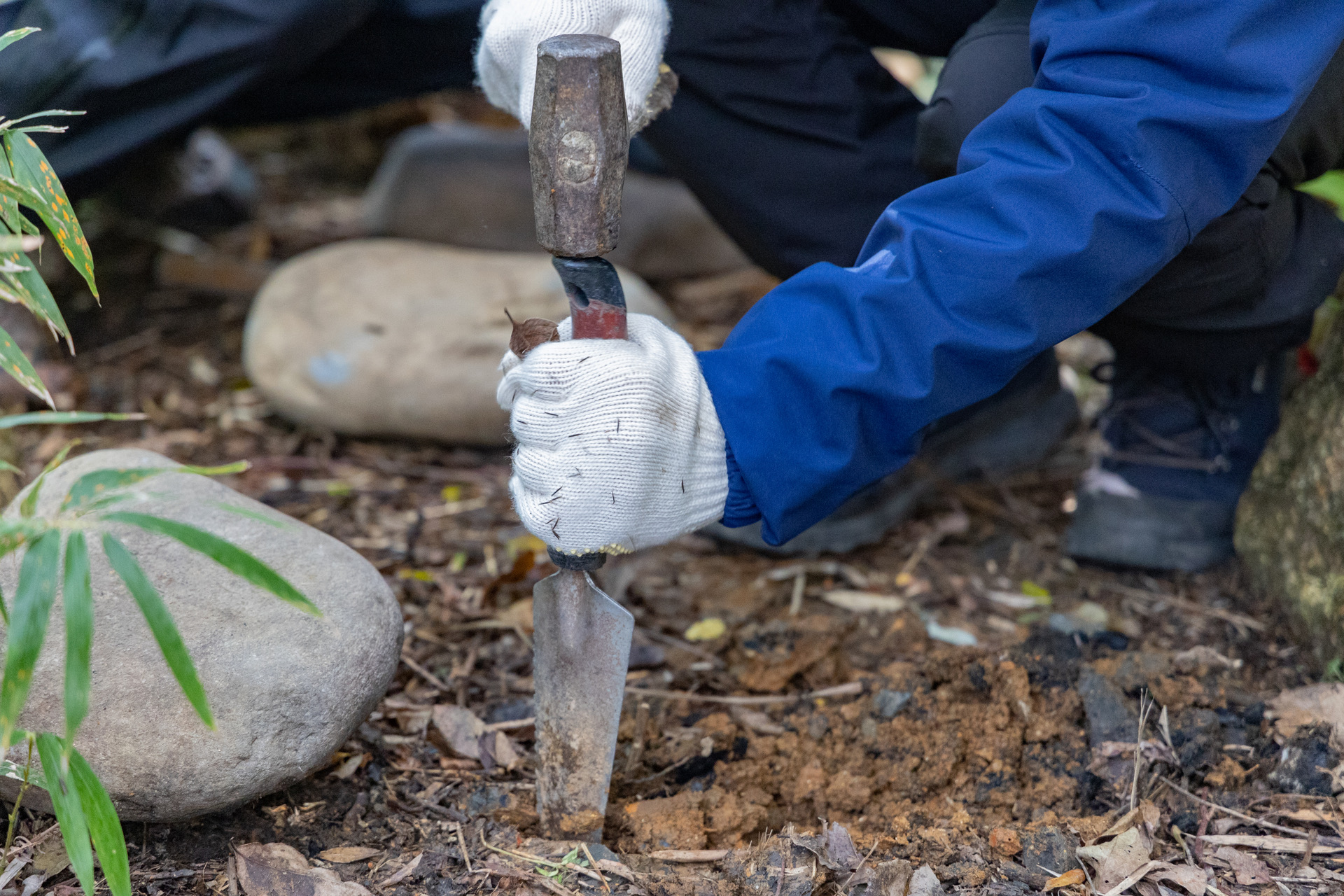
In softened ground, a 2-meter stake can be driven by hand. The key is to leave the tip slightly above the surface, for more than one reason:
- It becomes a foothold. Walking directly on the sludge tramples the soil and re-crushes the water-and-air pathways you just opened. Standing on exposed stake heads lets you work without damaging the site.
- It promotes breathing and agitation. The stake opens gaps so water and air circulate, gradually breaking down the sludge.
- It marks progress. You can see at a glance how far the treatment has reached, making re-work decisions easier.
Porous Charred Stakes and Bark-On Stakes Move Water
Material and surface finish matter too. Drive a porous charred stake, or a stake with the bark left on rather than planed smooth, and water travels up and down along the stake’s surface. A rough, porous surface functions as a conduit for water and air far better than a smooth-machined one — the same principle as “cracks move water” in stone work.
Guiding Trapped Water to Surface
Hidden within the sludge layer is trapped water (confined water) held under pressure with nowhere to go. This is not deep groundwater — it is stranded, in-between water. Pierce that layer with a porous stake and the trapped water finds a path up along the stake. Once that confined water starts moving, sludge breakdown accelerates sharply. Think of a stake not as “a pipe that drains water” but as “a primer that shows water the exit.”
The Role of Stones — Cracks and Voids Clear the Mud
Once the stakes get water moving, stones take over. Of all the materials in regenerative civil engineering, stone gives the most immediate result.
Why 10-20 Minutes of Stone-Setting Stops the Mud
A stone holds countless internal cracks and voids. Where mud is flowing, drive the stakes, then set stones before the mud finishes draining, stacking from the bottom up. In just 10-20 minutes of stone-setting, the highly fluid muddy water turns to a clear stream. The cracks become channels for water, while the fine particles in the mud settle out as they pass through the gaps. In one observation, even when the main river ran turbid and overflowed during rainfall exceeding 30 mm of continuous accumulation, the stone-set section alone stayed clear, with no flow of mud.
Backfill (Crushed Stone and Straw) Decides Durability
Once the stones stop the mud and the footing dries, the next course goes much faster. When it is too sludgy to add backfill (the fill packed behind the stones), simply interlocking stone against stone to carry the load still works. But for long-term stability, the standard is to pack guri-ishi (fist-sized crushed stone), straw, and fallen leaves behind the face. Plant willow behind the gabion and its roots weave into the crushed stone, integrating the structure so it grows more collapse-resistant year by year.
Combining Stakes and Stones — Embankment With Cribwork and Crushed Stone
Stakes and stones each work alone, but they show their true value combined — enabling something modern standard methods struggle with: building up an embankment on soft, marshy ground.
How to Raise About 2 Meters on Soft Ground
Pile excavated soil straight onto sludge and it gets squeezed out and slides away. Instead, build it like this:
- Assemble a cribwork (igeta) frame from stakes and logs.
- Set large stones into the frame to create a load-bearing base.
- Run a subsurface drain (ankyo) beneath it as well, securing an escape route for water.
- Layer tile, stone, and crushed stone alternately with the excavated soil, interlocking them as you backfill.
This sequence lets you raise up to roughly 2 meters — higher than head height at the tallest points — without blocking the subsurface flow or severing the water-and-air pathways. Modern standard construction retains almost no technique for safely building embankments on soft ground, which is exactly why this old combination of cribwork and crushed stone proves its worth on site.
Building Vertical and Horizontal Water Movement Together
Large embankments follow the same principle. Vertically, a well-like structure gathers water; horizontally, a stone-set subsurface drain releases it out the side. The holes you see here and there in a stone retaining wall are the outlets of those drains. Stakes carry the vertical water movement, stone work the horizontal — and only when both are present do you get an embankment that doesn’t collapse, and in fact tightens with age. Finishing with straw-filled earth bags helps too: the straw bags rot in about a year, but by then moss, grass, and roots have gripped the slope face, and the embankment stands on its own.
Before-and-After Results, and Field Judgment
Stake-and-stone work is undramatic to look at, yet the change is clearly observable. A slope toe that was saturated and absorbed no water at all shifts, after treatment, to a state where fallen leaves remain and the soil breathes. In a simple infiltration test (the double-ring method), the untreated slope toe absorbs almost nothing, and even exposed slopes lose capacity to the silt film — while a treated section, with leaf litter accumulating and breathing, absorbs water by an order of magnitude more. The fact that leaves stay put rather than washing away is itself the clearest proof the soil is breathing.
The key judgment: do not dig out the sides that are stable and where water moves well. Clean only the collapsing lines and the highly fluid “water paths,” tracing the curves nature has already drawn. In gravelly or stony soil, a low-resistance three-prong hoe digs more easily. Conversely, turning over everything or hardening even the stable parts destroys the very pathways you need. “Don’t touch what’s working” is the rule.
Summary
To recap the role of stakes and stones in regenerative civil engineering:
- Hardening backfires on soft ground: solidifiers and geotextiles stop water, marshing the slope toe and inviting collapse.
- Stakes are devices that move water: leave the tip exposed, use porous charred or bark-on stakes to pass water and air, and guide trapped water to surface.
- Stones clear muddy water through cracks and voids: set before the mud drains and it stops in 10-20 minutes, drying the footing for the next step.
- Cribwork plus crushed stone lets you embank soft ground: vertical stakes and horizontal stone work move water while raising up to about 2 meters safely.
- Don’t touch what’s working: clean only the water paths; leave the stable parts unexcavated.
Next time you stand on soft ground, drive one stake with its tip exposed and watch how the water moves at your feet. From there, the craft of stakes and stones becomes part of your field repertoire. To learn the full sequence step by step, see the EKAM Online Course.