

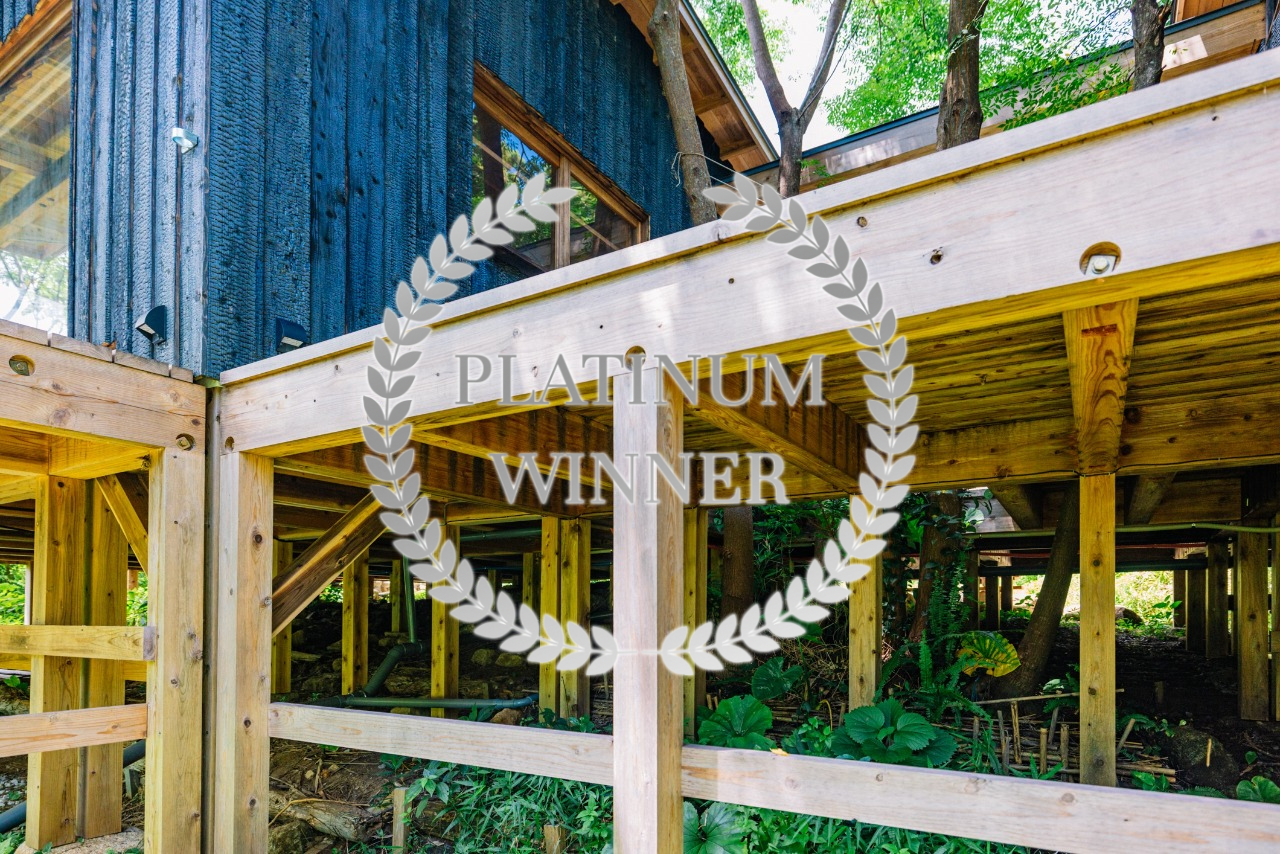
EKAM is honored to share that Regenerative Vegan House, an ishibadate (stone-foundation traditional Japanese architecture) home on Yakushima Island that we built, has been awarded the Platinum Winner in the Household & Residential Building Design category at the 5th International Architecture & Design Awards (IADA 2026), hosted by the Architecture Designers Community (ADC). The project was designed by Tsukasa Ono of tono Inc., with construction by EKAM.
Award page: View the official ADC announcement here
This article introduces what IADA 2026 is, then explains — in plain language without architectural jargon — why ishibadate, a Japanese building technique with over a thousand years of history, is now being highly evaluated by the global architecture community.
日本語版: 石場建がIADA 2026最高賞|日本の伝統工法が世界で評価された理由
What Is the IADA 2026 Award?
IADA (International Architecture & Design Awards) is an international architecture and design competition organized by the Architecture Designers Community (ADC). It receives entries from architects and designers around the world and recognizes outstanding work across diverse categories including residential, commercial, landscape, and interior design.
About the Organizer: Architecture Designers Community (ADC)
ADC, also known as the Architecture & Design Community, is an international online community of architects, designers, and educators. With over 300,000 followers across social media, it functions as a global hub where architecture and design professionals connect and share work.
The 5th Edition of a Truly Global Award
The 2026 edition marks the 5th milestone edition of IADA, with applications growing year over year. The judging panel comprises architects, designers, and educators based across the United States, Europe, and Asia, ensuring that work is evaluated through diverse perspectives unbound by any single regional or stylistic preference.
The Award Tiers and the Meaning of Platinum
IADA’s award structure consists of Platinum / Gold / Silver / Bronze tiers, with Platinum being the highest honor. It is awarded only to the most exceptional work in each category — the projects that demonstrate the strongest design philosophy, social significance, and technical innovation. In effect, it is the “summit” of that category for that year.
About the Award-Winning Work: Regenerative Vegan House
The award-winning project is a regenerative residence built within the forest of Yakushima — a UNESCO World Natural Heritage site. It uses no concrete foundation; instead, it is constructed using ishibadate, a traditional Japanese building technique with over a thousand years of history.
| Award | IADA 2026 Platinum Winner (highest tier) |
| Organizer | Architecture Designers Community (ADC) |
| Category | Household & Residential Building Design |
| Project Name | Regenerative Vegan House |
| Designer | tono Inc. (Designer: Tsukasa Ono) |
| Construction | EKAM |
| Location | Yakushima, Kagoshima Prefecture, Japan |
| Three Design Principles | ①Plant-based materials ②Ethical integration protecting habitats ③Regenerative practices restoring the environment |
What Is “Ishibadate”? (For Newcomers)
For those outside the architecture community, the term may be unfamiliar. In one sentence: ishibadate is a traditional wooden architectural technique in which wooden columns are placed directly on natural stones, without the use of any concrete foundation.
How Does It Differ from Modern Houses?
Most modern homes are built on a “slab foundation” — concrete poured over rebar dug into the ground. The earth and the building are completely fixed together by concrete.
By contrast, ishibadate places large natural stones (foundation stones) on the ground and rests wooden columns directly on top of them. There is almost no concrete or metal hardware between the column and the stone. This design intentionally leaves a continuous gap through which water, air, and soil organisms can move freely between the ground and the building.
Even Horyuji Temple Uses Ishibadate: The Secret of Thousand-Year Wooden Architecture
“A house that isn’t fixed with concrete” might sound concerning to some. In reality, however, most Japanese wooden buildings that have stood for over a thousand years — including Horyuji Temple — are built using ishibadate. Precisely because they are not fixed with concrete, moisture does not accumulate, earthquake forces are absorbed and dispersed, and damaged sections can be replaced piece by piece, keeping the building alive across generations.
Why the World Is Now Recognizing Ishibadate (Five Reasons)
Why is a building technique that has existed in Japan for over a thousand years now being chosen for the highest honor at an international design award in 2026? Behind this lies a major shift in values within the global architecture community.
1. Dramatically Lower Environmental Impact Across the Full Lifecycle
The architecture world today evaluates not only the impact of “building” but also of “using” and eventually “demolishing” — what’s known as full lifecycle carbon footprint. Concrete and steel produce enormous CO₂ emissions during manufacturing, and after demolition they become almost entirely industrial waste. Ishibadate, by contrast, is built from natural materials — stone, wood, soil — that return cleanly to the earth after demolition. Its design philosophy of “polluting nothing from the beginning to the end of the home’s life” aligns precisely with the global evaluation criteria.
2. Complete Material Circularity Using Only Natural Resources
The materials used in ishibadate — stone, wood, soil, grass, bamboo, and charcoal — all cycle through nature on a 100 to 200-year timescale. Chemical adhesives, preservatives, and termite treatments are kept to an absolute minimum, keeping indoor air quality healthy. This aligns directly with the “healthy building” concept that the global architecture industry now emphasizes.
3. A Seismically Intelligent Approach That “Absorbs” Earthquake Energy
Many people mistakenly assume that “ishibadate is weak against earthquakes.” The opposite is true: by allowing the columns to slip slightly on the stones, the design dissipates earthquake energy in a way similar to modern base isolation systems. Rather than rigidly resisting forces, it flexibly redirects them — a principle shared across many Japanese traditional construction techniques. As major earthquakes and severe typhoons continue to affect more regions worldwide, this wisdom is being re-evaluated as a vital approach.
4. Ease of Repair, Demolition, and Material Reuse
Concrete houses are difficult to repair once built and produce massive amounts of waste during demolition. Ishibadate, by contrast, is structurally designed for partial replacement — individual columns and beams can be exchanged one at a time. Foundation stones, beams, and columns can be reused indefinitely. In terms of architectural resource circulation, it represents an ideal example of the modern circular economy.
5. Continuity of Local Materials and Craftsmanship
Ishibadate is built using stones from the local land, regional timber, and the hands of local craftspeople. Free from dependency on globalized supply chains, it preserves both regional economies and traditional skills simultaneously. As the global architecture world re-evaluates vernacular architecture (architecture rooted in place), ishibadate stands out as one of its most refined examples.
How “Regenerative” Thinking Has Reached the Forefront of Global Architecture
The word “Regenerative” in the project’s title is one of the most closely watched concepts in the global architecture world today.
From “Sustainable” to “Regenerative”
For years, the architectural world’s guiding principle has been “sustainable.” But “sustainable” — interpreted strictly — means little more than “don’t make things worse.” It is, in essence, a concept of maintaining the status quo.
“Regenerative,” by contrast, is a more proactive idea: the very act of building and inhabiting should restore the land and ecosystem. Trees aren’t cut, the terrain isn’t reshaped, soil organisms aren’t damaged — instead, the existence of the home enriches the surrounding forest. This approach is becoming the new evaluation standard among IADA jurors and across the global architecture community.
The Three Design Principles Embodied by the Award-Winning Project
The award page outlines three design principles:
- Plant-based materials: an ethical choice to avoid animal-derived materials
- Ethical integration protecting habitats: preserving existing trees and soil ecosystems
- Regenerative practices restoring the environment: the act of building enriches the land
These principles can only be fully realized when the homeowner’s vegan lifestyle, the designer’s vision, and the builder’s craftsmanship align toward the same purpose.
Two Awards for One House: The Significance of IDA Bronze + IADA Platinum
Regenerative Vegan House previously won a Bronze Award at the 2025 International Design Awards (IDA). Combined with this Platinum at IADA 2026, the project has now received two international awards. For the IDA award details, see our previous IDA award article.
Recognition by two different organizations with two different juries demonstrates that the design philosophy of this house aligns not with any particular school or trend, but with a value system shared across the global architecture community. For the craftspeople and designers working with traditional Japanese techniques, this is a symbolic moment — Japan’s traditional architecture has been recognized not as a “local style,” but as a building philosophy with global relevance.
A Note from EKAM
EKAM specializes in regenerative civil engineering and landscaping, but traditional techniques like ishibadate align directly with our design philosophy. We avoid sealing the ground with concrete, leaving paths open for water, air, and mycelium — the same fundamental approach we apply whether we are building a home foundation or shaping a garden.
This house was made possible only because designer, builder, and resident all shared the same philosophy, on the rare ground of Yakushima — a UNESCO World Natural Heritage site. We feel this award has internationally affirmed that Japan’s traditional techniques can offer one meaningful answer to the planet-scale challenges of our time. We will continue to pass these techniques on to the next generation and apply them in real projects.
Summary
- Regenerative Vegan House, an EKAM-built ishibadate home in Yakushima, won the Platinum Winner award at the 5th IADA 2026, hosted by ADC
- Category: Household & Residential Building Design. Designed by tono Inc. (Tsukasa Ono)
- Ishibadate is “traditional architecture without concrete foundations” — the technique behind thousand-year wooden buildings such as Horyuji Temple
- Five reasons the world is recognizing it now: ① Low lifecycle carbon footprint ② Material circularity through natural resources ③ Earthquake-absorbing flexibility ④ Ease of repair and demolition ⑤ Continuity of local materials and craftsmanship
- The shift in architectural values from “sustainable” to “regenerative” aligns precisely with the philosophy of ishibadate
- Receiving a second international award after the IDA Bronze confirms that Japan’s traditional architecture is now recognized as a building philosophy with global relevance
Frequently Asked Questions
Q1. What kind of organization is ADC (Architecture Designers Community)?
ADC is an international architecture and design community whose members include architects, designers, and educators worldwide. With over 300,000 followers across social media, it organizes IADA — the International Architecture & Design Awards — annually.
Q2. How significant is the IADA Platinum Winner award?
The IADA tier structure is Platinum / Gold / Silver / Bronze, with Platinum being the highest. It is awarded only to the most exceptional work in each category, making it the “summit” of that year’s category.
Q3. Can ishibadate still be built in modern Japan?
Yes, it can. Under the Japanese Building Standards Act, special structural calculations such as ultimate strength design are required, but design firms and builders specialized in traditional construction can handle it. As this project shows, examples that combine traditional techniques with contemporary lifestyles are increasing.
Q4. What is the difference between “regenerative architecture” and “sustainable architecture”?
Sustainable architecture aims at maintaining the status quo (“don’t make things worse”), while regenerative architecture is the more proactive idea that the act of building and inhabiting should restore the environment. The leading edge of the global architecture world is shifting from sustainable to regenerative.
Q5. How can I learn to build my own ishibadate home?
EKAM’s online course teaches the design philosophy and construction techniques of regenerative architecture, including ishibadate, through video lessons and personal support. Both architecture and landscape professionals as well as individuals planning their own home or garden are welcome.