

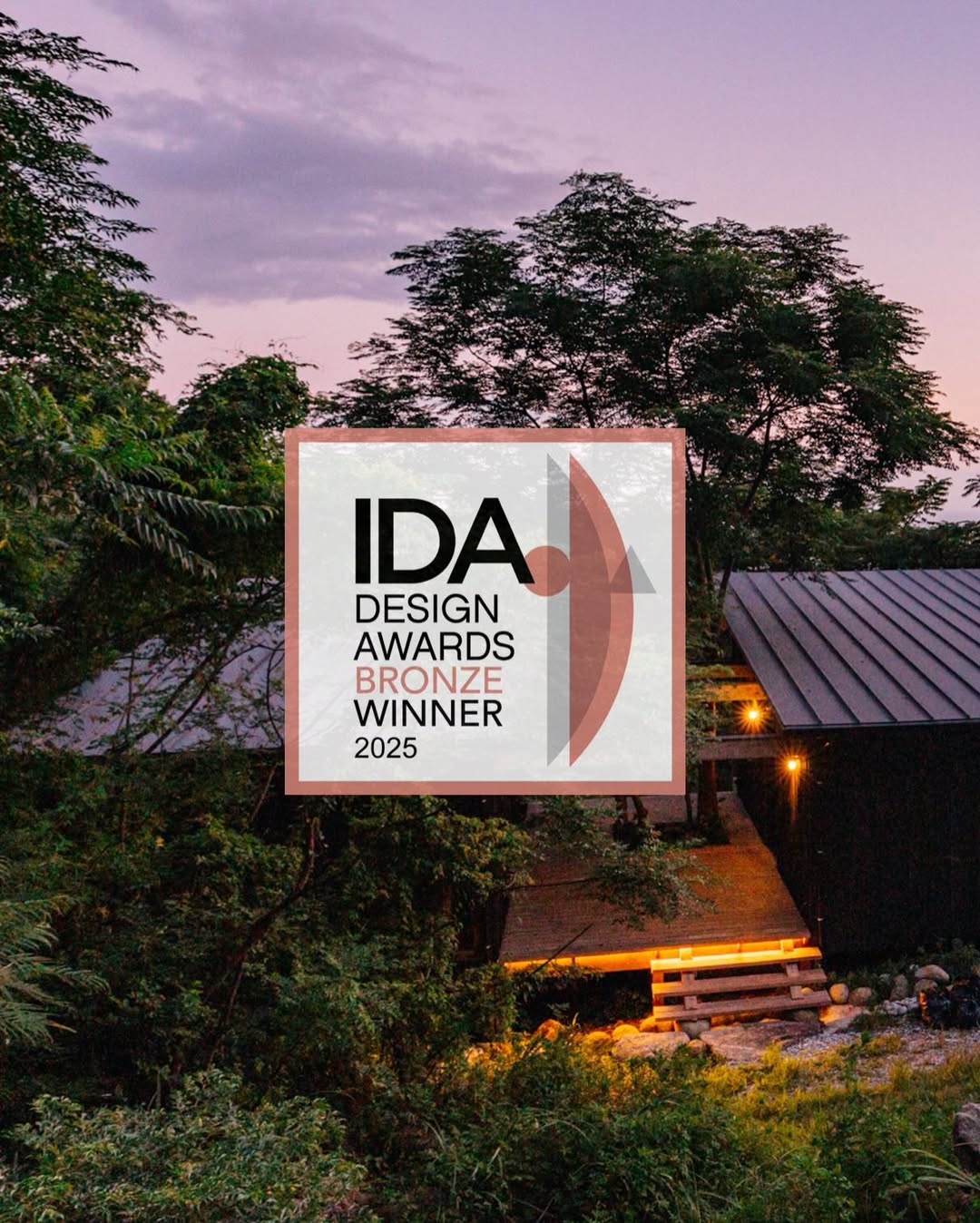
EKAM is pleased to share that Regenerative Vegan House, an ishibadate (stone-foundation traditional Japanese architecture) home we built, has received a Bronze Award at the International Design Awards (IDA) 2025. Built within the forest of Yakushima, this regenerative home was designed by Tsukasa Ono of tono Inc. with construction by EKAM.
This article introduces what the IDA Design Awards 2025 are, the features of the award-winning project, and how the Japanese traditional techniques of ishibadate and raised-floor design serve Yakushima’s distinctive climate and ecosystem — explained from our position as the team that built it.
日本語版: 屋久島の石場建の家がIDA 2025受賞|高床式と森と暮らす環境再生型住宅
What Is the IDA Design Awards 2025?
The IDA Design Awards (International Design Awards) is an international design competition founded in 2007 in Los Angeles, USA. It honors outstanding work from around the world across diverse design fields including architecture, interior, graphics, fashion, and product design. Each year, thousands of submissions arrive from over 60 countries, with Gold, Silver, and Bronze winners selected in each category.
The Award Category and Evaluation Points
Our project received a Bronze Award in the Residential Architecture / Sustainable Home category. Among submissions from around the world in the “sustainable housing” space, the project was evaluated on its design philosophy, environmental consideration, use of local materials, and continuity of craftsmanship.
| Award | IDA 2025, Bronze |
| Category | Residential Architecture / Sustainable Home |
| Project Name | Regenerative Vegan House |
| Designer | tono Inc. (Designer: Tsukasa Ono) |
| Construction | EKAM |
| Location | Yakushima, Kagoshima Prefecture, Japan |
What Is Ishibadate? A Japanese Tradition over a Thousand Years Old
Ishibadate is a traditional Japanese wooden-architecture technique in which wooden columns are placed directly on natural foundation stones, without using any concrete foundation. The fact that millennium-old wooden buildings such as Horyuji Temple still stand today is largely thanks to this technique.
How the Ishibadate Foundation Works
The award-winning project’s foundation embodies the essence of regenerative ishibadate. Within the ground, the following layered structure is integrated:
📐 Foundation cross-section (top to bottom)
- Wooden Pillar (structure): A wooden column is fixed to the foundation stone via metal hardware
- Foundation Stone (granite): A natural stone is placed as-is. No concrete is used
- Cobblestone & Crushed Stone Layer: Stones surround and underlie the foundation stone, dispersing load
- Charcoal Layer: Bamboo and wood charcoal are buried, regulating humidity and creating a microbial habitat
- Wooden Stakes: Driven vertically, creating pathways for water and air
- Mycelium Network: Over time, fungal threads spread, granulating the soil
How It Differs from Modern Reinforced Concrete Foundations
A standard reinforced concrete (slab) foundation completely separates the building from the ground and bears the load above as a continuous “surface.” Ishibadate, by contrast, bears the load through stones and stakes — as “points” and “lines” — and intentionally leaves a continuous space through which water and air can flow between the ground and the building. This prevents moisture buildup and creates a base-isolation-like effect: during earthquakes, the building can slip slightly on the stones to dissipate impact.
Raised-Floor Design: Redefining the Relationship Between Ground and Building
Another key feature of the award-winning project is its raised-floor design, lifting the floor several tens of centimeters to over a meter above the ground. In Japan, this design has a long history dating back to Yayoi-era raised-floor storehouses, and it has been widely adopted across Southeast Asia and the South Pacific.
The History and Modern Significance of Raised-Floor Design
Raised-floor design is more than just “moisture protection.” By creating a space between the ground and the building, it produces multiple compounding effects:
- Protects the wooden structure from ground moisture, mold, and termites
- Allows wind to pass beneath the floor, dramatically improving summer cooling
- Preserves the surface ecosystem, leaving paths open for plants and small animals
- Reduces flood damage risk during heavy rainfall events
- Makes building maintenance and inspection easy (you can crawl beneath the floor)
Architectural Features of the Award-Winning Project: Designing With the Forest
Photographs of the award-winning project reveal several distinctive features.
Yakisugi (Charred Cedar) Exterior Walls
The exterior is finished in yakisugi — charred cedar boards. By carbonizing the surface of cedar planks, this traditional Japanese technique enhances rot, insect, and fire resistance without any chemical treatment. Over time, the surface develops a beautiful silver-to-black patina, and is said to last 50 to 80 years maintenance-free.
An Architectural Plan That Preserves Existing Trees
Existing trees on the site rise straight up through the central deck of the building. Rather than felling trees and grading the land, the building was designed around the trees’ positions — this is the core philosophy of regenerative architectural design. The shade the trees cast, the soil their roots build, and the insects their leaves nurture all become part of the home’s living environment.
Living Close to the Earth, While Caring for the Earth
The exterior decks are wooden, maintaining a connection to the ground while preserving the soil from compaction. Cobblestones and fallen leaves are layered around the foundations to prevent surface runoff, creating a structure where each rainfall delivers organic matter into the ground.
Five Reasons Ishibadate × Raised-Floor Design Excels in Yakushima
Yakushima is a UNESCO World Natural Heritage island with a distinctive climate and ecosystem. For a home built in this place, ishibadate combined with raised-floor design is not merely a return to tradition — it is the most rational choice for this climate and terrain.
1. Exceptional Resilience to Heavy Rain and Humidity
Annual rainfall in Yakushima reaches around 4,500 mm in lowland areas and 8,000 to 10,000 mm in the mountains — three to six times the Japanese national average (around 1,700 mm). In such an environment, a reinforced concrete foundation traps moisture inside, leaving the wooden structural members in a permanently damp state and inviting rot fungi and mold. Ishibadate, by contrast, allows constant air circulation through the gaps between stones, preventing moisture accumulation.
2. Cool Crawl-Space Ventilation Even in Hot, Humid Weather
The raised-floor design lets wind pass beneath the floor, keeping the interior cool in summer. The home maintains comfortable indoor conditions through natural ventilation alone, without relying on air conditioning. In Yakushima’s warm climate, this passive cooling effect benefits the home year-round.
3. Dramatically Reduced Termite and Rot Risks
Because the structure does not directly contact the ground, termite entry routes are physically restricted. The design prevents termite damage through architecture rather than chemical treatments — an approach with major long-term benefits for both building lifespan and maintenance costs.
4. Architecture That Coexists With Trees
Yakushima’s forest is a precious World-Heritage ecosystem. Concrete foundations and the grading they require destroy the soil, root networks, and microbial systems beneath them. With ishibadate × raised-floor design, existing trees can be preserved, root systems left intact, and soil ecosystems maintained — all while building a home. The award-winning project’s design, with trees rising straight through the building’s center, is the visual expression of this philosophy.
5. Flexible Resilience to Typhoons, Earthquakes, and Floods
Yakushima also lies in a typhoon path. Raised-floor design physically reduces the risk of floor-level flooding during heavy rainfall. Ishibadate, meanwhile, allows columns to slip on foundation stones to dissipate earthquake energy — a base-isolation-like effect. While rigid concrete foundations attempt to absorb earthquakes through stiffness, ishibadate responds with the principle of “deflection.”
The Design Philosophy Behind a “Regenerative” Home
The name Regenerative Vegan House embodies a philosophy that goes beyond “sustainable.” “Regenerative” means more than reducing environmental impact: living in the home should actively restore the surrounding environment.
This home combines the following elements:
- Construction was completed without felling a single existing tree, with minimal terrain modification
- The foundation incorporates charcoal, fallen leaves, and wooden stakes to cultivate a mycelium network
- Yakisugi exterior walls and locally sourced timber, with chemical treatments minimized
- Native plants are placed around the home to restore biodiversity
- The resident’s lifestyle (vegan) and the architectural philosophy work in concert
The name “Vegan House” reflects the residents’ choice not to consume animal products. The home itself follows the same principle: “using no animal-derived materials” and “designing without harming other living beings” — keeping architecture and lifestyle consistent.
Reflections from the Construction Team
EKAM specializes in regenerative civil engineering and landscape design, but traditional techniques like ishibadate align directly with our design philosophy. We avoid sealing the ground with concrete, leaving paths open for water, air, and mycelium — the same fundamental approach we apply whether we are building a home foundation or shaping a garden.
This home was made possible only because designer, builder, and resident shared the same philosophy, in the rare environment of Yakushima. We feel this award has internationally affirmed that Japan’s traditional techniques can offer one meaningful answer to the environmental challenges of our time.
Summary
- The EKAM-built Yakushima ishibadate home Regenerative Vegan House received a Bronze Award at the IDA Design Awards 2025
- Category: Residential Architecture / Sustainable Home. Designed by tono Inc. (Tsukasa Ono)
- Ishibadate is a thousand-year-old traditional technique that places wooden columns directly on natural foundation stones, leaving paths for water, air, and mycelium
- Raised-floor design delivers compounding benefits: ventilation, moisture protection, coexistence with trees, and flood resilience
- For Yakushima’s heavy rain, humidity, heat, typhoons, and unique ecosystem, ishibadate × raised-floor design is the most rational choice
- “Regenerative” describes the philosophy that living in the home should actively restore the surrounding environment
Japan’s traditional techniques contain wisdom that can answer many of the environmental challenges of our era. EKAM continues to pass these techniques on to the next generation and apply them in real-world projects.
Frequently Asked Questions
Q1. Aren’t ishibadate homes weak against earthquakes?
The opposite is true. Ishibadate provides a base-isolation-like effect: columns can slip on the foundation stones to dissipate earthquake energy. The fact that most thousand-year wooden buildings, including Horyuji Temple, are built using ishibadate is empirical proof. Note that under modern building codes it requires special handling, so designers should choose specialists experienced in traditional construction.
Q2. Can ishibadate homes be newly built today?
Yes, they can. Under the Japanese Building Standards Act, special structural calculations such as ultimate strength design are required, but design firms and builders specialized in traditional construction can handle it. As this project demonstrates, examples that combine modern lifestyles with traditional techniques are increasing.
Q3. Are raised-floor homes cold underneath?
Not if insulation and air-tightness are properly designed. In fact, the airflow beneath the floor keeps the home cool in summer, and prevents ground-level cold from transferring directly to the floor in winter. In warm regions like Yakushima, the design offers especially significant benefits.
Q4. Is ishibadate × raised-floor design effective outside Yakushima?
Yes, very much so. The benefits are particularly strong in regions with heavy rainfall, high humidity, frequent typhoons, or flood risk. The fact that traditional Japanese homes were historically built using these methods speaks to their effectiveness.
Q5. How can I learn to build regenerative homes or gardens?
EKAM’s online course teaches the design philosophy and construction techniques behind regenerative architecture, including ishibadate, through video lessons and personal support. Both architecture and landscape professionals and individuals planning their own home or garden are welcome.