

日本語版: 雨庭とは何か|関東の水害から考える、庭でできる環境再生型の水害対策
In September 2015, a levee on the Kinu River failed in Joso City, Ibaraki Prefecture, flooding roughly 40 square kilometers — about a third of the city. In October 2019, Typhoon Hagibis pushed the Tama and Arakawa river systems to their highest recorded water levels; in Kawagoe, Saitama, a levee on the Oppe River gave way, and 245 residents and staff of a nursing home had to be rescued by boat. Flooding in the greater Tokyo region is no longer a rare event. This article looks at the structural reasons behind that trend, and at one thing homeowners can actually do about it on their own land: the rain garden. Our conclusion up front — flood resilience is no longer solely the job of government agencies and river authorities. How individual properties handle their soil is becoming part of the flood defense of an entire watershed, and that includes what happens in an ordinary backyard.
Why Flooding Is Increasing in the Kanto Region
Short, intense downpours are becoming measurably more frequent
According to Japan Meteorological Agency statistics, the number of hourly rainfall events exceeding 50 mm — classified as “very heavy rain” — rose from an average of 173.8 occurrences per year (1976–1985) to 232.1 (2007–2016), roughly a 1.3-fold increase. Events exceeding 80 mm per hour, classified as “violent rain,” increased roughly 1.7-fold over the same period. Rising temperatures are understood to increase atmospheric moisture, fueling stronger updrafts and more intense storm development. This is not a Kanto-specific phenomenon — it is happening across Japan.
Urban flooding from overwhelmed drainage, not just river failure
“Flood” often conjures images of a river breaching its banks. But the more common event in dense urban areas is internal drainage failure: storm sewers and drainage channels are generally designed around roughly 50 mm of rainfall per hour, and once rainfall exceeds that, water with nowhere to go backs up into streets and residential areas. In heavily urbanized central Tokyo, the amount of ground available for water to infiltrate has shrunk considerably, concentrating large volumes of stormwater into drainage systems within a very short window.
A Policy Shift: Watershed-Wide Flood Management
In response, Japan’s Ministry of Land, Infrastructure, Transport and Tourism has been advancing a policy shift known as ryuiki chisui (watershed-based flood management) since roughly 2020. The idea is that flood defense is no longer the sole responsibility of river authorities — national and local government, businesses, and residents across an entire watershed each take on a share of the work: not just channeling water away, but holding it, slowing it, and preparing for it. Within this policy, traditional “gray infrastructure” (concrete embankments, storm sewers) is positioned not as a rival to “green infrastructure” (vegetation and soil that absorb and slow water) but as something that needs to work alongside it. The rain garden is exactly this green-infrastructure approach, scaled down to an individual residential lot.
What a Rain Garden Actually Is
From “channel it away” to “catch it and let it soak in”
A rain garden is a planted depression that catches rainwater running off impervious surfaces — a roof, a driveway — instead of sending it straight into a storm drain, and lets it soak into the ground over time. The US Environmental Protection Agency defines this kind of feature as a shallow depression designed to temporarily hold stormwater, generally sized so the collected water infiltrates within roughly 72 hours. That 72-hour figure isn’t arbitrary — beyond it, roots risk oxygen starvation, and standing water becomes a mosquito breeding ground.
The four basic building blocks
- Map the water’s path: understand where rain from the roof, driveway, or other hard surfaces actually collects.
- Shape a shallow, bowl-like depression: at the lowest point of the property.
- Build a permeable soil profile: gravel and crushed stone beneath a well-draining topsoil layer.
- Choose plants that tolerate both wet and dry conditions: soil that’s temporarily saturated after rain and dry again once the sun returns.
Reading the Rain Garden Through a Regenerative Lens
This is exactly where our own work in regenerative landscaping and civil engineering intersects with this idea. Before it was a Western-originated concept, the core of the rain garden overlaps almost exactly with the principle Japanese regenerative landscaping has emphasized for generations: keeping air and water flowing continuously through the soil.
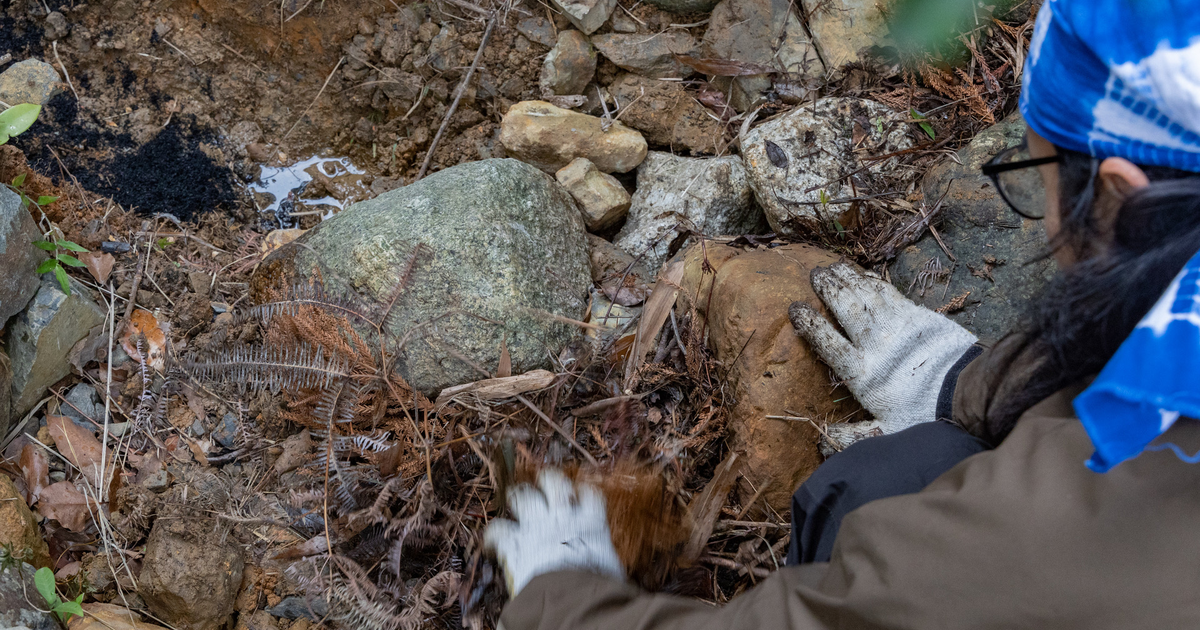
Catching water in a shallow depression and letting it infiltrate is close in spirit to the traditional Japanese practice of digging infiltration pits and drainage channels along a site’s natural water paths. But in Japan’s high-rainfall, steep terrain, importing an overseas design template unmodified isn’t always enough. If a soil’s aeration has already been lost, shaping a depression alone won’t make water drain. Pairing a rain garden with traditional groundwork — staked timber and crushed stone that restore air and water pathways through the soil — turns it into a genuinely functioning, living system rather than a shape that looks right on paper.
Modern drainage systems built around non-woven geotextile filters or cement-based soil stabilizers carry a real risk of clogging or failing again within a few years to a decade or more. A rain garden built on restored soil aeration and infiltration is a way to sidestep that weakness altogether.
What the Evidence Shows
Research on bioretention systems similar to rain gardens has reported peak-runoff reductions ranging from roughly 30% to 99%, depending heavily on soil condition, design, and storm intensity — a wide enough range that no single blanket percentage should be claimed. Even so, the underlying logic — catching stormwater on-site and returning it to the ground gradually instead of rushing it downstream through concrete — is backed by substantial measured data showing it eases pressure on downstream systems.
Portland, Oregon has built out an extensive network of rain gardens and other green stormwater infrastructure over roughly three decades. Compared with relying solely on upgrading pipe capacity, the shift to a sustainable stormwater strategy has reportedly delivered significant cost savings. Street-level rain gardens (green streets) have also been reported to remove a substantial share of pollutants from runoff, delivering water-quality benefits alongside flood mitigation.
In Japan, public installations are emerging in places like Musashino City, Hachioji City, and Yokohama. Nagaike Park in Hachioji has incorporated a rain garden built around wetland plants, combining stormwater management with landscape design. Most Japanese examples so far remain concentrated in public facilities and university campuses rather than spreading across residential neighborhoods the way they have in parts of the US — which also means individual residential adoption is still largely untapped ground.
Deciding Whether a Rain Garden Fits Your Property
- Good candidates: yards where roof or driveway runoff consistently pools in one spot, or where drainage feels poor after every heavy rain, tend to see the clearest improvement.
- What to watch for: on some terrain, simply shaping a depression won’t be enough — if the surrounding soil has lost its aeration, you may end up creating a new standing-water problem instead of solving one. Assessing the soil’s actual infiltration condition before designing is essential.
- Sites near retaining walls or slopes: because a rain garden deliberately concentrates water, its effect on nearby retaining wall or slope stability needs to be part of the design conversation — this is not a decision to make alone; consult a professional.
- From one yard to a whole watershed: a single rain garden holds back only a small volume of water on its own, but under the watershed-management approach, many such properties acting together add up to a real reduction in a region’s flood risk.
Frequently Asked Questions
Q. What is a rain garden?
A rain garden is a planted depression that catches rainwater running off impervious surfaces like a roof or driveway, instead of sending it straight into a storm drain, and lets it soak into the ground over time. It typically consists of a shallow bowl-shaped depression, a permeable soil profile, and plants that tolerate both wet and dry conditions.
Q. Why are rain gardens relevant to flooding in the Kanto region?
Japan Meteorological Agency statistics show hourly rainfall over 50 mm increased roughly 1.3-fold between 1976–1985 and 2007–2016. Urban areas are prone to drainage-system failure when storm sewers, generally designed for about 50 mm per hour, are overwhelmed. Japan’s watershed-based flood management policy calls for shared responsibility including individual properties, and rain gardens are one concrete way to participate.
Q. How does the rain garden concept connect to regenerative landscaping?
The rain garden’s core idea — catching and infiltrating stormwater — overlaps closely with the aeration-and-infiltration principle central to Japanese regenerative landscaping and civil engineering. Combining it with traditional stake-and-crushed-stone groundwork, which restores air and water pathways through the soil, makes a rain garden function more reliably.
Q. How much flood protection does a rain garden actually provide?
Research on similar bioretention systems reports peak-runoff reductions ranging roughly from 30% to 99%, varying heavily by soil condition, design, and storm intensity, so no single figure applies universally. Still, the underlying approach — holding stormwater on-site and releasing it gradually — is well supported by data showing it eases pressure on downstream systems.
Q. What should I watch for before building a rain garden at home?
Depending on terrain and soil condition, simply shaping a depression may not be enough to drain properly and could create standing water instead. On properties near retaining walls or slopes, deliberately concentrating water can affect structural stability, so it’s important to assess soil infiltration and consult a professional before building one, rather than deciding alone.
Summary
- Statistically, short intense downpours are increasing across the Kanto region, raising both river-overflow risk and urban drainage-failure risk.
- Japan’s watershed-based flood management policy calls for shared responsibility across government, business, and residents — and the rain garden is one concrete way an individual property can participate.
- A rain garden catches and infiltrates stormwater rather than channeling it away, built from a shallow depression, permeable soil, and appropriately chosen plants.
- The rain garden concept overlaps deeply with the aeration-and-infiltration principle long central to Japanese regenerative landscaping, and works best paired with traditional stake-and-stone groundwork.
- Reported effectiveness varies widely by condition, but the core logic — catch water on-site, return it to the soil gradually — consistently eases pressure downstream. Assess soil condition and any impact on retaining walls or slopes with a professional before building one.