

Japanese version: 庭が冠水する家のNG対策3つ|大雨の水を「雨庭」で受け止める手順
Every heavy rain, the yard turns into a pond.
The path to the front door disappears under water. When it finally drains, a skin of mud is left behind, and the lawn and shrubs look a little weaker each season.
Most homeowners with a flooded yard reach for one of three fixes: bring in fill soil, pave it over, or bury a drain pipe.
Yet on site we keep seeing the same pattern: yards treated with only these three fixes are often flooding again a few years later.
The reason is simple. Yard flooding is rarely about too much water. It is about water that has nowhere to go.
This guide explains why yards flood, and how to turn the problem spot into a rain garden — a shallow planted basin that catches stormwater and hands it slowly to the ground — from the viewpoint of regenerative landscaping as practiced in Japan.
Why Yard Flooding Happens: It Is About Exits, Not Rainfall
Under the same storm, one yard floods and the next one does not.
The difference is whether rain has two exits: soaking into the ground, and leaving the site slowly. A yard floods when both exits are blocked.
Exit 1 blocked: the ground no longer absorbs water
Soil compacted by machinery during construction, paths walked on for years, ground sealed under weed fabric — in all of these the pore spaces between soil particles have collapsed.
Without pores, neither water nor air can enter. Rain runs across the surface and collects at the low point.
Worse, muddy water leaves a thin crust of fine silt when it dries. That crust makes the next storm infiltrate even less. Flooding breeds more flooding.
Exit 2 blocked: water cannot leave the site
A yard boxed in by block walls and concrete slabs is a shallow dish. Add a lot that sits lower than the road, runoff from a neighbor, and downspouts that discharge straight onto the lawn, and the dish fills in minutes.
A roof is a bigger collector than most people think. Thirty millimetres of rain on a 50 m² roof is 1,500 litres — seven or eight bathtubs — delivered to one or two downspout outlets.
IN ONE LINE
Yard flooding is “cannot soak in” plus “cannot get out.” Finding which exit is blocked is where every fix begins.
Three Common Fixes for a Flooded Yard — and Where They Fall Short
None of these is wrong. Each is sometimes necessary. The trouble starts when it is the only thing done.
1. Raising the grade with fill soil
The puddle disappears from that spot, but the water does not. It moves toward the foundation, the neighbor, or the street. Compacting the new fill adds yet more surface that cannot absorb rain.
2. Paving everything, or weed fabric plus gravel
The mud is gone, but so is nearly all infiltration. Almost every drop now runs off, so when a storm exceeds the capacity of the drain inlet, flooding can actually get deeper.
Where paving is needed, give the runoff from that paving a place to land.
3. Burying a drain pipe or dry well and nothing else
French drains and dry wells work well when the surrounding soil lets water reach them. In compacted ground it never arrives, and muddy inflow clogs the system within a few years.
In one infiltration test in an urban woodland, saturated low ground absorbed almost nothing — the finding was that infiltration hardware does little unless water in the soil is moving again.
THE COMMON THREAD
All three stop at pushing the water somewhere else.
Water pushed away becomes flooding elsewhere on the lot — or for someone downstream.
Turning a Flooded Yard into a Rain Garden
A rain garden is a shallow planted depression that collects runoff from roofs and paving and lets it soak into the ground over one to two days.
We recommend it for flood-prone yards because it converts the weakness — the place where water gathers — into a function: the place that receives water.
For the background and its link to basin-wide flood management in Japan, see our introduction to amaniwa, the Japanese rain garden.
| Push-it-away fixes | Rain garden | |
|---|---|---|
| Approach | Move water off site fast | Catch it and pass it to the ground |
| In a big storm | Overflows once capacity is exceeded | Basin acts as temporary storage |
| Over the years | Clogging and settlement reduce function | Roots and soil life increase infiltration |
| Value as a garden | More hardscape | More flowers and habitat |
Step 1: Diagnose Your Yard Flooding
Walk the yard in the rain
- Where water enters: downspouts, neighboring lots, the street, paved areas
- Where it collects: the last place to drain, and how deep
- How long it stays: hours from the end of rain until it is gone
Take photos and video. They become your design drawings.
A simple percolation test
- Dig a hole about 30 cm wide and 30 cm deep.
- Fill it once and let it drain completely to pre-wet the soil.
- Fill it again and measure how far the water drops in one hour.
| Drop per hour | Verdict | What to do |
|---|---|---|
| 2.5 cm or more | Well suited | Build the basic design |
| 1–2.5 cm | Workable | Make the basin wider and shallower; add vertical channels |
| Under 1 cm | Heavy clay or severe compaction | Improve the soil first; consult a professional |
If water is still standing after 24 hours, or seeps up from the bottom, the water table may be high. Digging a basin there can make things worse — do not proceed on your own.
IF YOU REMEMBER ONE THING
A walk in the rain and one test hole. Those two steps reveal most causes of yard flooding.
Step 2: Siting and Sizing the Rain Garden
- At least 3 m (10 ft) from the house, so water is not concentrated at the foundation
- On the downhill side where water naturally heads — but just upslope of the single worst spot that never drains
- Away from retaining walls, slopes, septic tanks and buried utilities
For a home rain garden, 10–20% of the contributing roof or paved area is a useful starting size. A 50 m² roof needs roughly 5–10 m².
Depth of 10–20 cm is enough: 10 m² at 15 cm holds 1,500 litres — the full 30 mm storm from that roof. Shallow, wide, with gentle edges is the rule for both safety and looks.
Step 3: Building It the Regenerative Way
A conventional rain garden swaps the native soil for a sandy mix. We add techniques handed down in Japanese regenerative earthwork — ways of reopening paths for water and air — which matter most in ground compacted enough to flood.
Inlet: a meandering stone-lined swale
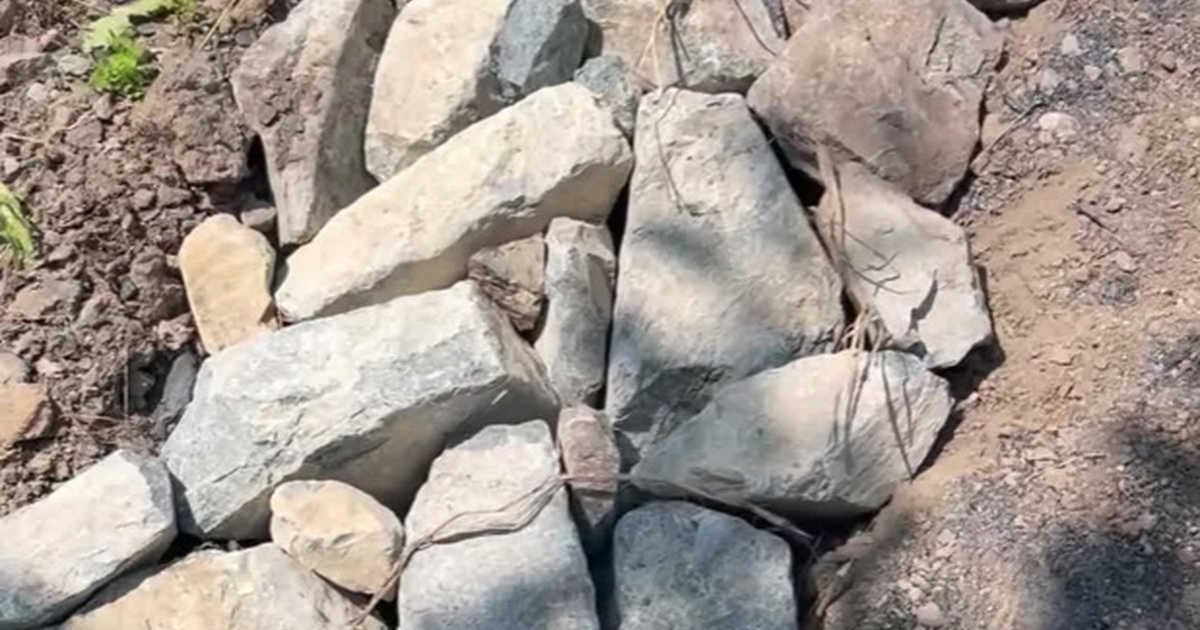
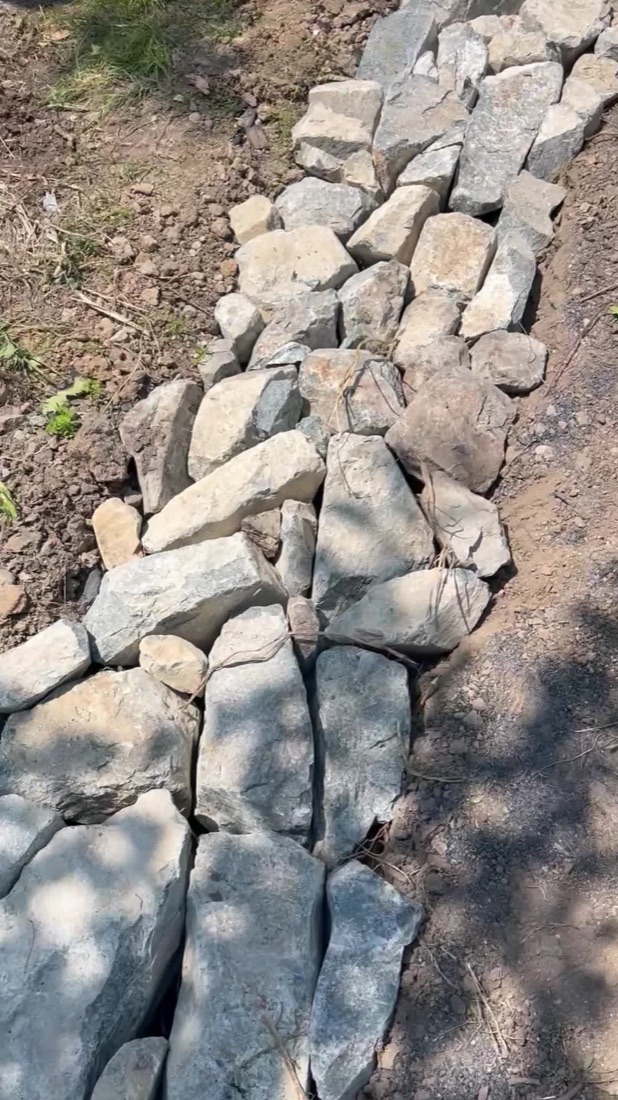
Lead water from the downspout in a shallow swale that curves gently and is lined with fist-sized stones. The flow slows, silt settles along the way, and cleaner water reaches the basin. Set a larger stone where the water lands to stop scouring.
Basin floor: vertical “point holes”
Bore holes 15–20 cm wide and 30–50 cm deep every 1–2 m across the floor (known in Japan as ten-ana). Fill them loosely with charcoal, pruned branches and leaf litter — never packed tight.
They pierce the compacted layer so water can move down and air can move up. Fungal hyphae and roots colonise the organic fill, and the holes mature into living conduits. Far less soil has to be excavated and hauled away than with full replacement.
Surface: leaf litter, so no silt crust forms
Bare soil is hammered by raindrops into a sealing crust. A cover of leaves, clippings or wood chips absorbs the impact.
In one field test, a bare slope took in about 200 mm per hour and declined as a silt film formed, while ground under accumulated leaf litter absorbed more than 500 mm per hour with no film at all.
Overflow: always give the big storm a way out
Lower one point of the rim by a few centimetres, armour it with stone, and direct overflow away from the house toward an existing drain or the street gutter. A rain garden without an overflow is just a deeper puddle.
Planting by zone
| Zone | Conditions | Examples (Japan) / equivalents |
|---|---|---|
| Centre | Periodically submerged | Sweet flag (Acorus gramineus), loosestrife, Japanese iris, sedges |
| Slope | Alternately wet and dry | Hosta, liriope, Iris japonica, Eupatorium |
| Rim | Mostly dry | Hydrangea, nandina, kerria, ornamental grasses |
Favour species native to your region, and mix rooting depths so the soil gains channels at several levels.
What Changes After You Build One: Infiltration That Grows with Time
Flooding does not vanish on day one. In the first year you will see the basin fill after a big storm and drain over half a day to a day. That is the rain garden working.
At one clay site where holes were structured with stakes, stone and straw, a 20 cm puddle that took three hours to soak in right after construction drained in seconds to minutes one year later.
Test pits showed no clogging — instead, aggregated soil, wider pores and gathering roots. Engineered hardware performs best on the day it is finished. A structure that puts roots, fungi and soil life to work gets better with age.
Results vary with soil and rainfall, and no figure can be promised for every yard. But time being on your side is common to many sites.
COMMON MISTAKES
- Water stands for 3+ days: the percolation test was skipped or the water table is high. Add point holes or relocate.
- Erosion at the inlet: place stone and add curves to the swale.
- Mosquito worries: larvae need roughly a week of standing water. A basin that drains in 1–2 days is a poor breeding site.
Where a Rain Garden Fits — and When to Call a Professional
Good candidates
- Flooding is caused by roof and pavement runoff collecting in the yard
- Water clears on its own within a day or two
- A few square metres are available 3 m or more from the house
Not enough on its own
- River flooding or street flooding entering the lot: beyond what one yard can handle — check hazard maps and municipal measures first
- On or near retaining walls and slopes: concentrating water can affect stability
- High water table or springs: a different design is required
- Past crawl-space or floor-level flooding: get a whole-site drainage assessment
Many municipalities subsidise rainwater infiltration and storage. It is worth a search for your area.
Frequently Asked Questions
Q. What is the main cause of yard flooding?
Yard flooding is caused less by the amount of rain than by water having nowhere to go. Soil compacted by machinery or foot traffic stops absorbing water, walls and paving stop it leaving the site, and downspouts concentrate roof runoff at one point. When these combine, even a short intense storm floods the yard.
Q. Can I build a rain garden myself to fix yard flooding?
Yes, if a percolation test shows the water level dropping 2.5 cm or more per hour and the site is level and at least 3 m from the house. Dig a basin 10–20 cm deep, bore vertical holes in the floor and fill them loosely with charcoal and branches, mulch with leaf litter, and build an overflow. Consult a professional near retaining walls or where the water table is high.
Q. How big should a rain garden be?
A home rain garden is typically 10–20% of the roof or paved area draining to it, and 10–20 cm deep. A 50 m² roof needs about 5–10 m². A 10 m² basin 15 cm deep temporarily holds about 1,500 litres, equal to 30 mm of rain falling on that roof.
Q. Will a rain garden breed mosquitoes?
Mosquito larvae need about a week of standing water to mature. A rain garden is designed to drain within one to two days, so a properly functioning one is a poor breeding site. Water standing for three days or more signals insufficient infiltration that should be corrected.
Q. Will a rain garden stop yard flooding completely?
A rain garden reduces flooding caused by runoff from roofs and paving; it cannot be guaranteed to prevent flooding in every storm. River flooding and large inflows from the street are beyond the scale of a single lot. Always include an overflow that directs excess water safely away from the house.
Summary: From Pushing Water Away to Receiving It
- Yard flooding is “cannot soak in” plus “cannot get out”
- Fill, paving or a pipe alone does not change where the water goes
- A rain garden turns the spot where water gathers into the spot that receives it
- Start with a walk in the rain and a one-hole percolation test
- Point holes, leaf litter and roots make infiltration grow year after year
Next time it rains, take an umbrella into the yard. Where does the water come from, and where does it stop? Once you can see that, half of your rain garden is already sited.
To learn these methods in depth, see the EKAM Online Course.