

日本語版: 造園の土づくりが先な理由|植栽やデザインの前に下地を整える手順
When people plan a garden, they usually start with what they can see: trees, stones, lawn, a deck. That is natural. But I recommend changing one thing about the order. Prepare the soil for landscaping before you decide on the planting or the design.
The reason comes from what I have seen on site again and again. If you leave the soil as it is and simply plant, the garden does not get better afterward. What keeps a garden looking good over time is the water and air you cannot see.
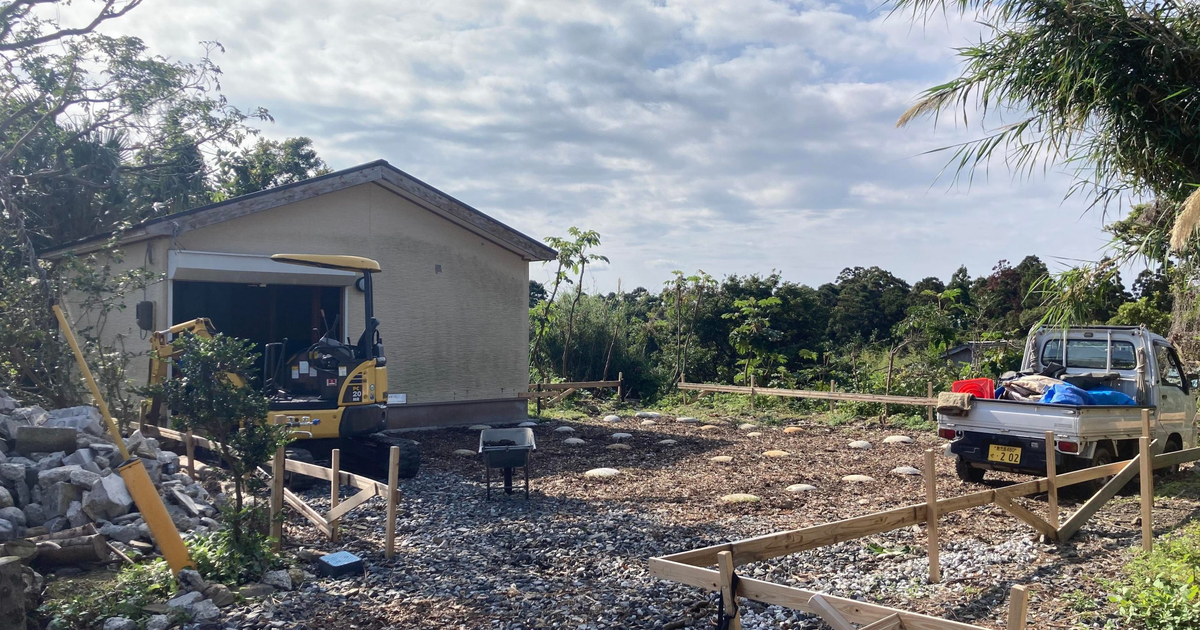
A site from August 2026 showed this clearly. A construction path beside a building had been trampled hard. Runoff from the roof and scaffolding poured onto it, and the path itself became a watercourse, difficult even to walk on. We solved it by separating the footpath from the flow of surface water. Trees planted into ground like that have nowhere to send their roots.
Why Soil Preparation Comes Before Planting and Design
The hidden half that holds a tree up
Roots do more than absorb water and nutrients. They breathe. Soil therefore needs pathways for air as well as water. Technical guidance on urban greening in Japan identifies two main causes of poor tree growth on graded land: soil too hard for roots to penetrate, and poor air and water movement that leads to root rot.
The planting base
Japanese public greening practice calls this foundation the shokusai kiban, or planting base, and the layer roots can occupy the effective soil depth. It is sized so that a tree can anchor against strong wind and draw enough moisture through a dry spell without irrigation. In short, whether a tree stands for decades is largely settled before it is planted.
What Happens When You Start With What Shows
- The planting hole becomes a pot. Good soil in a hole surrounded by hard ground holds water with nowhere to go. Roots suffocate or circle inside the hole.
- Compaction stays below the surface. Grading the top does not remove the hard layer left by machines and foot traffic. Granite-derived soil, common across western Japan, passes little water or air once compacted.
- Rain with no destination cuts into the ground. Surface flow carries off the topsoil first, exposing the base of young plants.
Five Steps of Soil Preparation Before Planting
A principle shared across regenerative design worldwide runs in this order: manage water, restore air, add nutrients, then choose plants. Skip a step and much of what you invest above ground tends to wash away.
Step 1: Read the soil
A hoe or spade is enough. Walk the site in the rain and record where water runs and collects. Dig about 30 cm and check the depth of dark topsoil, the hardness, and any foul smell. Pour water into the hole and compare how fast it drains from place to place. Professionals measure hardness and permeability by depth with a soil penetrometer and a simple field permeability tester.
Step 2: Protect the topsoil
Overseas sources report that topsoil forms naturally at only about 2 to 4 tonnes per hectare per year. Strip it, store it at the edge of the site, keep it separate from the subsoil, and return it at the end. Never leave disturbed ground bare before the next rain.
Step 3: Build pathways for water
Decide where rain is received and where it goes. In rainy Japan the key is to slow water down and let it soak in, using swales, point holes and rain gardens as the site requires. Keep footpaths and water flows apart.
Step 4: Let air through hard layers
Deep tilling across the whole site destroys soil structure. Instead, pierce the hard layer at points with stakes and small holes. At one of our foundation-stone sites we drilled 5 mm holes in the excavation floor, inserted charcoal and organic material, and drove a 60 mm charred stake to open a vertical path for water and air. Keep machinery off wet soil and confine it to a single route.
Step 5: Add organic matter and cover the surface
Once the pathways exist, add leaf mould, charcoal, prunings and cut grass. They shelter fungi and microbes and encourage soil aggregation. Fertiliser comes after this, because roots that cannot breathe cannot use it. Finish by covering the surface with leaves, branches and grasses.
The Right Order for Everything Above Ground
This is not an argument against design. It means letting the soil set the terms of the design: read the site; fix the positions of buildings, paths and water; finish heavy machine work; build the base; plant the main trees; plant shrubs and ground layers; add the finishing touches. Choose plants that suit each part of the site rather than trying to make all of it uniformly rich.
What Changes, and What We Cannot Promise
Change shows first on the ground: puddles clear faster, the surface darkens and gains some spring, earthworms and white fungal threads appear, and the mix of grasses shifts. Records from sites elsewhere in Japan report leaf-covered ground absorbing more than 500 mm of water per hour, against about 200 mm on a bare slope. Results vary widely with the land, the rainfall and the work done, so we cannot promise the same outcome. Expect a process of several years.
Practical Judgment for New Builds and Existing Gardens
- New builds: decide water pathways and the topsoil store when you site the building.
- Existing gardens: start small around your weakest tree or wettest spot, then expand.
- Leave to specialists: ground behind retaining walls, slopes, areas near foundations, and anywhere with buried pipes.
If you read Japanese, our official LINE account offers a free site-diagnosis checklist for reading your own soil: EKAM official LINE. You can also reach us through the contact page.
Frequently Asked Questions
Q. Why prepare the soil before planting a garden?
Roots need pathways for both water and air. If the ground is hard or does not drain, roots spread poorly and plants tend to weaken within a few years. Preparing the soil first helps planting and design last.
Q. Is adding good soil to the planting hole enough?
Not if the surrounding ground stays hard. The hole can fill with water like a pot and starve roots of oxygen. The surrounding layers and the path of the water must be addressed too.
Q. How long does soil preparation take to show results?
It depends on the land, the rainfall and the work done. Drainage can change quickly, while soil structure and plant growth change over several years.
Summary
- Prepare the soil before planting and design, because roots need paths for both water and air.
- Good soil in a hard hole acts like a pot; address the surrounding layers and where the water goes.
- Work in five steps: read the soil, protect topsoil, build water paths, let air through, add organic matter and cover.
- Start small in existing gardens and consult a specialist near walls, slopes and foundations.